

The Modern Shoulder - Desk Posture, Stability & Injury Prevention
Did you know that for every inch your head moves forward, the load on your neck and shoulders increases by 10 pounds? With the average office worker spending over 7 hours per day sitting at a desk, it's no surprise that shoulder pain has become a modern epidemic. Studies show that up to 67% of people will experience shoulder pain at some point in their lives—yet most cases are preventable with the right knowledge and habits.
Whether you're typing at a computer, lifting at the gym, or simply going about daily life, understanding your shoulder health is essential for lifelong function and pain-free movement.
The Hidden Link: Screen Time & Shoulder Dysfunction
Your shoulder wasn't designed for hours of sustained forward reaching. When we sit at computers, scroll on phones, or hunch over laptops, we place our shoulders in a compromised position for extended periods. Overtime, this leads to predictable patterns of muscle imbalance and joint stress.
What Happens to Your Shoulder During Screen Time?
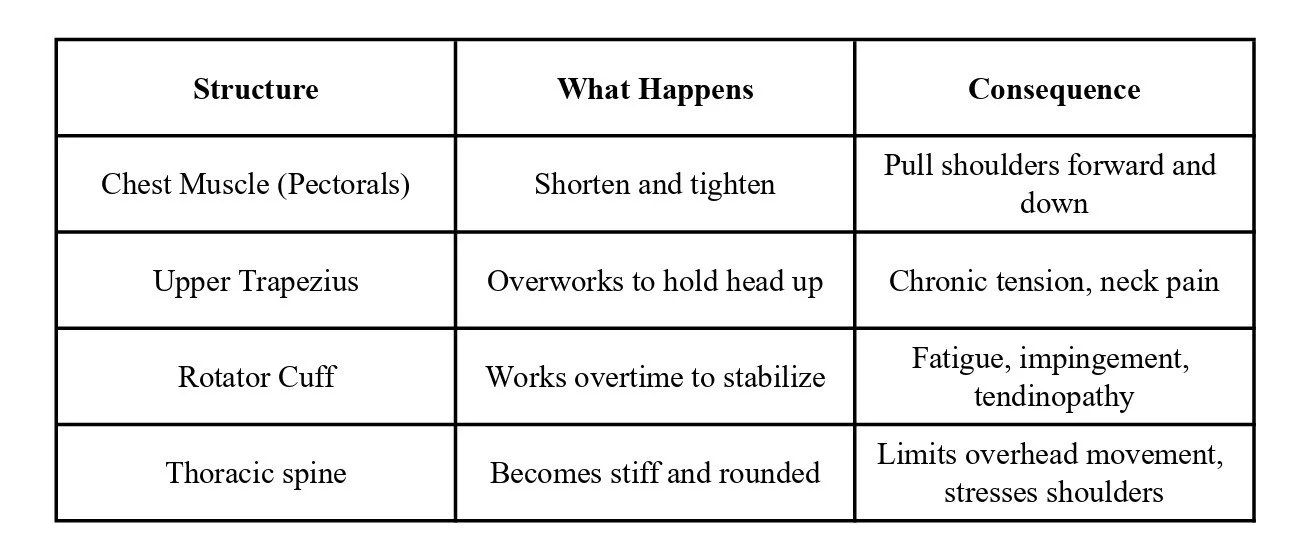
The result? A shoulder joint that sits in a forward, internally rotated position- the perfect setup for pain, dysfunction and injury.
Upper Crossed Syndrome: The Postural Pattern You Need to Know
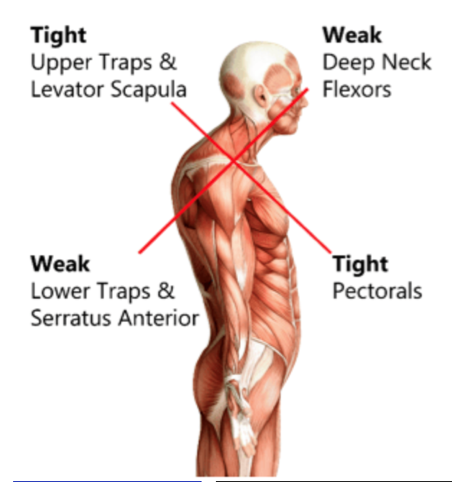
Upper Crossed Syndrome (UCS) is a predictable pattern of muscle imbalance common in desk workers and technology users:
Tight Muscles (Overactive)
Upper trapezius, Levator Scapulae, Pectoralis Major and Minor
Weak Muscles (Underactive)
Deep neck flexors, Lower trapezius, Serratus anterior, Rhomboids
This “crossed” pattern- tight in some areas, weak in others- alters shoulder mechanics, impairs rotator cuff function, and creates the perfect environment for impingement, bursitis and even rotator cuff tears.
Q&A: Common Shoulder Questions Answered
Q: Why does my shoulder hurt even though I don’t lift heavy weights?
A: Shoulder pain isn’t always about load- it’s often about position. Poor posture places your shoulder joint in a compromised position during everyday activities like typing, driving, or even sleeping. The rotator cuff muscles become overworked simply trying to stabilize an unstable joint. Think of it like a car wheel out of alignment- even driving slowly causes uneven wear.
Q: Can poor posture really cause rotator cuff issues?
A: Absolutely. When your shoulders roll forward, the space within the joint—called the subacromial space—narrows significantly. This pinches the tendons and bursa between your bones, leading to impingement. Over time, this repeated compression causes fraying, degeneration, and eventually tears of the rotator cuff tendons. What starts as a posture problem can become a structural one.
Q: When is shoulder pain a neck problem?

A: Surprisingly often. The nerves that supply your shoulder (C5, C6) originate in your neck. When these nerve roots are irritated - due to disc issues, arthritis, or joint dysfunction - they can refer pain to specific areas:
C5 irritation: Pain to the shoulder blade and outer arm.
C6 irritation: Pain to the outer forearm, thumb and index finger.
This is called cervical radiculopathy or referred pain. A thorough assessment by a physiotherapist can determine whether your shoulder pain is truly coming from your shoulder—or if your neck is the hidden culprit.
Q: How do I know if my shoulder pain is serious?
A: While most shoulder pain responds well to conservative care, seek immediate attention if you experience:
Inability to lift your arm against gravity
Significant weakness or numbness
Pain at night that wakes you consistently
No improvement after 2-3 weeks of self-management
History of trauma or fall
Our Physiotherapy Approach to Shoulder pain
Phase 1: Comprehensive Assessment
We identify postural contributors, muscle imbalances, joint mobility and movement patterns to determine the root cause of your pain.
Phase 2: Manual Therapy
Soft tissue release for tight chest, upper trapezius, and neck muscles
Joint mobilization to restore shoulder and thoracic spine mobility
Phase 3: Scapular Stabilization Retraining
Teaching proper shoulder blade control during arm movement
Activating lower trapezius and serratus anterior
Phase 4: Rotator Cuff Rehabilitation
Progressive strengthening from isometrics to full-range movement
Eccentric control for tendon health
Phase 5: Ergonomic & Lifestyle Integration
Workstation optimization for neutral shoulder position
Movement breaks and sleep posture guidance
Key Takeaways:
1. Shoulder pain is often a posture problem first. Address the foundation.
2. Upper Crossed Syndrome is predictable and treatable. Identify your pattern.
3. The neck and shoulder are connected. Find the true source.
4. Stability matters more than strength alone. Control precedes load.
5. Small daily habits create big changes. Prevention is key.